Treasures of Turkey
Delve into the rich culture and history of Turkiye on an intoxicating journey across this incredible land.
- Return flights
- 11 nights in 4-star hotels and 23 meals
- 23 meals: 11 breakfasts, 2 lunches and 10 dinners
Delve into the rich culture and history of Turkiye on an intoxicating journey across this incredible land.
A chance to explore breathtaking sights in three fascinating South American countries.
Stunning Roman ruins can be found throughout Rome, with arches, temple fragments, and time-worn paving stones threaded through modern streets and piazzas.
Must-see Roman ruins include the Colosseum, the Roman Forum and Palatine Hill, Circus Maximus, Trajan’s Column, and the Pantheon.
Explore further with the Arch of Constantine, Baths of Caracalla, Largo di Torre Argentina, plus the more unexpected Pyramid of Cestius, the Theatre of Marcellus, and the Portico d’Ottavia.
On Travelsphere’s Grand Tour of Italy, enjoy a guided tour of Rome’s key sights, plus free time to explore Roman ruins at your own pace.
For lovers of ancient history, Italy’s Eternal City can feel less like a typical holiday destination and more like an open-air museum. This is the city that, according to legend, was founded by twin brothers Romulus and Remus. It grew from a riverside settlement into the capital of a vast empire, layering temples, arches, bathhouses and forums into the fabric of everyday life.
Ancient ruins can be found at every turn; beside bustling roads, at the edges of lively piazzas, and tucked down quiet side streets you might otherwise stroll past. Marble and tarmac coexist. Ancient paving stones, worn smooth by centuries of footsteps, still lead you onwards, often to a shady café terrace, where modern Rome carries on around you.
Interested in an Italy tour holiday to explore the best Roman ruins? As part of Travelsphere’s Grand Tour of Italy, you’ll enjoy a guided tour of Rome’s key sights, followed by a free afternoon and a full day for independent exploration.
Read on for 13 Roman ruins in Rome that you might choose to explore during your free time in the city. With so much to enjoy, you might focus on seeing as many as time allows, or simply choose a few favourites and treat the rest as reasons to return.
Discover our complete range of Italy holidays.
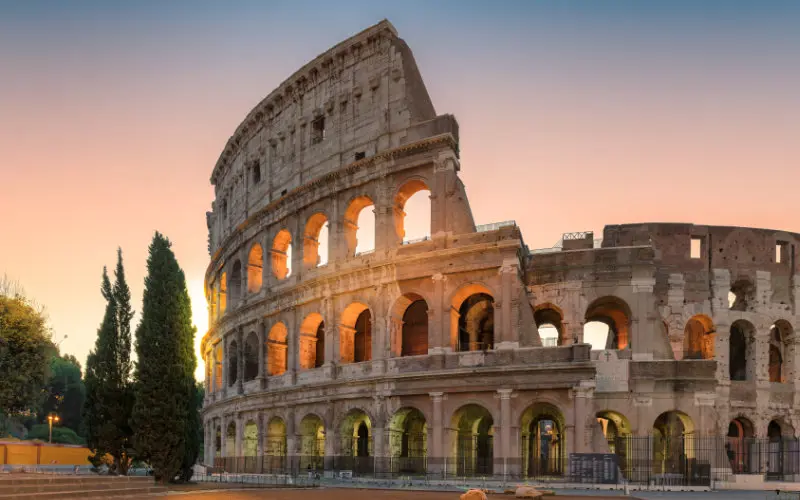
There are few moments in travel that feel as cinematic as your first proper sight of the Colosseum. Its honey-coloured stone catches the sun, the arches rise in tiered rows like a giant ribcage, and the sheer scale makes you instinctively imagine the roar of Roman spectators.
Built in the 1st century under Emperor Vespasian, it was the largest amphitheatre in the Roman Empire. It was Rome’s ultimate showpiece, designed to project power and keep the crowds entertained with gladiatorial contests, staged hunts and public executions.
Once you’re inside, the Colosseum’s vast oval shape is even more striking. Look down into the arena, then up at the arches layered in three architectural orders. The ingenious design was built for strength and for guiding thousands of spectators in and out with impressive efficiency.
For photos, head to the upper levels to capture the full ellipse of the arena and the layered seating in a single frame. If time is tight, stick to the main circuit and the best viewpoints down into the centre.
Read our guide to 30 fascinating facts about Italy.
How long to spend visiting the Colosseum
Many visitors spend around 1-2 hours exploring inside. It’s worth booking a timed entry so you can enjoy it without rushing, and if you’re planning to continue your ancient-history walk, look out for combined tickets that include the Colosseum, the Roman Forum and Palatine Hill.
Just next to the Colosseum, the Arch of Constantine stands proudly at the edge of the open space; a lasting lesson in imperial messaging.
Built to celebrate Emperor Constantine the Great’s military victory in AD 312, much of the sculpture was taken from earlier monuments, an intentional act of recycling that tells an ancient tale of power and legitimacy.
Visitors can see the mix of architectural styles and older reliefs that sit alongside later carvings. The way the Arch of Constantine frames the Colosseum behind it can create a particularly striking photo opportunity.
How long to spend visiting the Arch of Constantine
Many visitors spend around 10-15 minutes here.
The Forum was once the beating heart of ancient Roman life. It wasn’t a single building, but the political and social core of the city, made up of temples, basilicas, triumphal arches, civic offices, and busy thoroughfares. This is where speeches were delivered, laws debated, business conducted, and emperors and citizens alike lived their daily lives.
Even now, with the orators long gone and market stalls disappeared, the Roman Forum is impressive. Walking here is wonderfully immersive, with towering columns, triumphal arches, fractured pediments, and fragments of temples and basilicas. Some visitors find that focusing on one main route makes it easier to notice the layers of rebuilding over the centuries.
For the clearest views across the Forum, many people head to higher ground – even a slight change in viewpoint can give your photos a new perspective.
How long to spend visiting the Roman Forum Interior
Many visitors spend around 45–60 minutes exploring here.
Read our guide on the best time to visit Italy.

On the central Palatine Hill, myth and archaeology sit side by side. If the legends are to be believed, this was the birthplace of Romulus, the founder of Rome, who was raised by a she-wolf. As time drew on, the Palatine Hill later became prime imperial real estate, dotted with opulent palaces that came to define the word ‘palace’ itself.
Palatine is worth it for the views alone. From various points on the hill, you can look down over the Forum and the Circus Maximus. Treat it like a scenic, story-rich detour; a short climb, a few standout viewpoints, and then onward.
How long to spend visiting Palatine Hill
Many visitors spend around 45-90 minutes here.
The Circus Maximus is easy to see from the top of the Palatine Hill. What used to be an enormous arena for chariot racing is today a free public park. This is one of those sites where the imagination does the heavy lifting. Stand still for a moment and take in the length of the open valley below you to get a sense of the mass spectacle that the Romans once enjoyed.
Like other Roman ruins in Rome, you can get particularly close to the scattered ruins that once made up the Circus Maximus, including the cavea (seating areas), spina (central barrier), and carceres (starting gates). You may also notice later structures, such as the medieval Torre della Moletta, which hint at how the site has evolved over the centuries.
How long to spend visiting Circus Maximus
Many visitors spend around 15-30 minutes here.
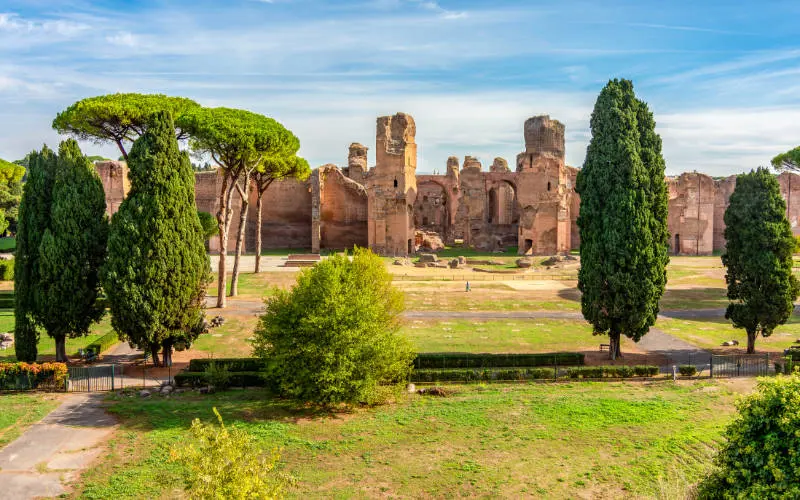
If the Colosseum and Circus Maximus show Rome’s love for spectacle, the baths show its appreciation for more relaxed socialising. Members of the public bathe and relax there, but also exercise, meet friends, and study.
Set away from the busiest ancient sites, the Baths of Caracalla started construction in the early 3rd century and was completed in AD 216, making this the city’s second-largest public baths. Even as well-preserved ruins, they still retain a sense of grandeur, with vast vaulted spaces, remnants of detailed mosaics and polished marble, a complex layout of warm rooms, plunge pools, and outdoor swimming areas.
How long to spend visiting the Baths of Caracalla
Many visitors spend around 1-2 hours exploring.
Read our guide on what to drink in Italy.
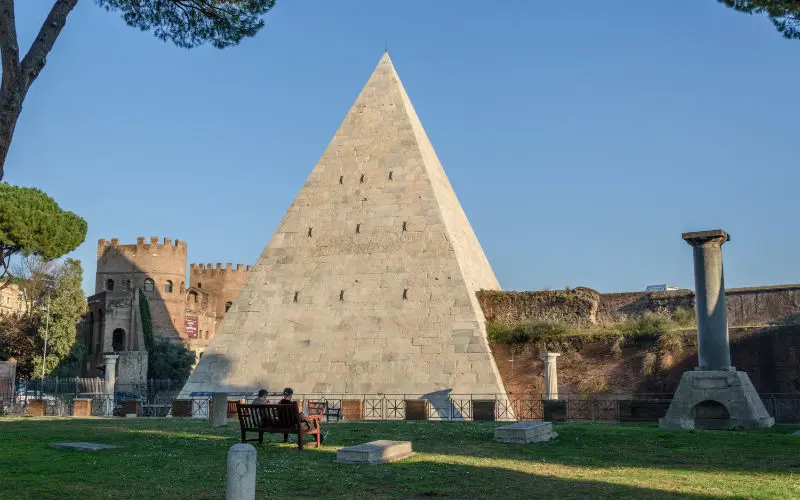
A little further from the centre of Rome, you’ll see one of the city’s more unexpected, eye-catching monuments – the Pyramid of Cestius.
Built as a tomb for Caius Cestius between 18 and 12 BC, this marble Roman pyramid reflects the empire’s fascination with Egypt after Rome’s conquest and its tendency to absorb various cultures.
Its clean lines and strong silhouette make the exterior particularly photogenic as it rises sharply beside the later city walls. It’s slightly outside Rome’s central cluster, so think of this as a worthwhile add-on if you’re feeling energetic or want something visually different from columns and arches.
How long to spend visiting the Pyramid of Cestius
Many visitors spend around 10-15 minutes here.
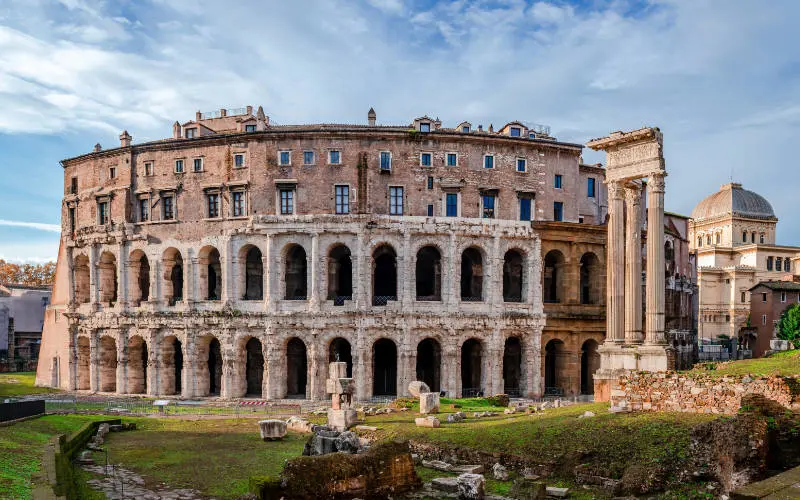
Back towards the centre, the Theatre of Marcellus reveals ancient architecture that has been continuously adapted over time.
Begun by Julius Caesar and completed by Emperor Augustus in 13 BC to honour his nephew, this open-air theatre once hosted pantomimes and musical performances for the Roman public. It later found new life as a fortress and then a palazzo.
You don’t even need to step into the theatre to appreciate its scale and influence. Its tiered exterior, decorated and supported by three distinct column types, is considered a major architectural inspiration for other Roman buildings, including the Colosseum.
How long to spend visiting the Theatre of Marcellus
Many visitors spend around 5–10 minutes here.
A short walk north-west from the Theatre of Marcellus, you’ll find the Portico d’Ottavia. This crumbling landmark once housed a library and temples to Juno and Jupiter. Now, it’s the gateway to the city’s later, wider history, including Rome’s Jewish ghetto.
The portico itself, once dedicated to Emperor Augustus’s sister, Octavia, is an elegant reminder of Roman imperial architecture. You may notice the fluted columns, intricate entablature, and subtle signs of repair after multiple fires and years of weathering.
How long to spend visiting the Portico d’Ottavia
Many visitors spend around 5–10 minutes here.
Arguably one of central Rome’s most absorbing ancient sites, this sunken area contains four Republican-era temples and was also home to the Curia of Pompey, the location widely associated with Julius Caesar’s assassination in 44 BC.
In recent years, the Largo di Torre Argentina has become more accessible, with raised walkways that allow travellers the chance to enjoy closer views. The temple still retains the spirit of ancient Rome, before the city was filled with imperial showpieces.
Largo de Torre Argentina is also known for the many cats that live there. When the walkways are closed, you’ll still find plenty of people looking over the handrails trying to spot them basking in the evening sun.
How long to spend visiting the Largo di Torre Argentina
Many visitors spend around 30-60 minutes here.
In the area around Piazza Venezia, close to the modern heart of the city, stands a tall column. A spiral relief winds around the monument as an intricately carved narrative commemorating Emperor Trajan’s victory in the Dacian Wars.
Even if you’re not a historian, the detail is mesmerising with figures marching, building, negotiating and fighting. It’s like a stone storyboard from nearly two thousand years ago.
How long to spend visiting Trajan’s Forum and Column
Many visitors spend around 30 minutes here.
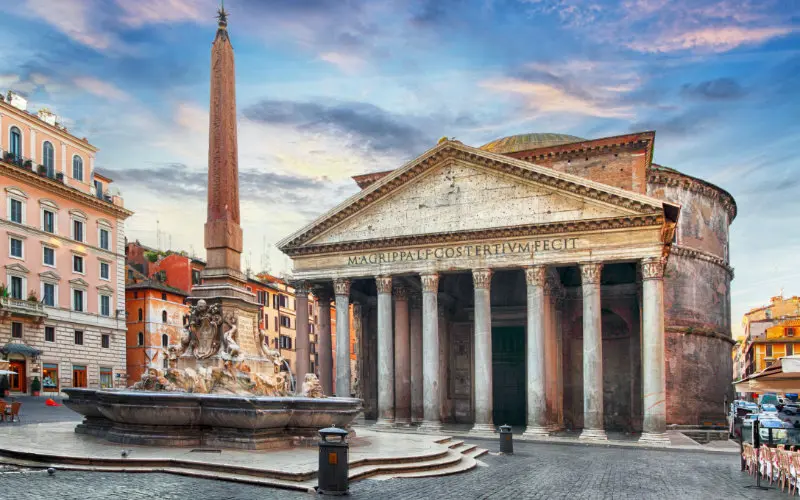
Within walking distance of several other historic sites in central Rome, the Pantheon is one of the best-preserved ancient buildings in Rome. While it’s not strictly a ‘ruin’, it showcases Roman engineering at its most confident, right down to the 22 drainage holes hidden in its floor, designed to carry away rainwater.
Originally built during the reign of Augustus’ right-hand man, Agrippa, and later reconstructed by Emperor Hadrian, it was converted into a church centuries ago.
Inside, the experience is immediate and sensory. Experience the cool air, soft echoes, a vast dome that seems to float, and the oculus, a circular opening to the sky, that pours daylight into the space like a spotlight.
How long to spend visiting the Pantheon
Many visitors spend around 30-45 minutes exploring.
In Piazza della Bocca della Verità, the Temple of Hercules Victor is a circular marble temple dating to the late 2nd century BC. Nearby, the Mouth of Truth is a huge ancient marble mask associated with the legend that it would bite the hand of anyone who told a lie.
How long to spend visiting the Temple of Hercules Victor and the Mouth of Truth
Many visitors spend around 20–30 minutes here.
Discover the best time to visit Italy.
Rome is a thrilling city with so much to enjoy. On Travelsphere’s Grand Tour of Italy holiday, a Holiday Director leads curated excursions of the highlights for you and your group with the help of Specialist Local Guides. They can also offer advice on how to approach a day of exploring Rome’s Roman ruins, or suggest the best local spots for relaxing with a coffee.
Escorted touring offers reassurance: comfortable, well-located hotels, organised transport, and the perfect pace for sightseeing and relaxation.
Explore our full selection of Italy escorted tours and guided holidays.
Part of the Royal Geographical Society collection, travel from top to toe and explore Italy’s famous landmarks. Visit iconic cities Venice, Florence and Rome and discover the hidden gems of Pompeii, Sicily and more.