Top 5 Jordan sights

Quick read...

  • Explore Jerash, one of the Middle East’s best-preserved ancient cities, with its Roman temples, theatres and colonnaded streets.

  • Experience Wadi Rum’s otherworldly desert landscape, spectacular sunsets and star-filled night skies.

  • Discover Madaba’s intricate mosaics and take in the historic views from nearby Mount Nebo.

  • Walk through Petra’s dramatic Siq, admire the Treasury and explore monuments including the Royal Tombs and Monastery before floating in the mineral-rich Dead Sea.

  • See these unforgettable Jordan sights together on Travelsphere’s expertly planned Jordan’s Ancient Wonders escorted tour.

Updated 31 July 2026

The best sights in Jordan include the ancient city of Petra, the desert landscapes of Wadi Rum, the Roman ruins of Jerash, the mosaics of Madaba and Mount Nebo, and the remarkable Dead Sea.

Together, these unforgettable places reveal Jordan’s extraordinary variety. One day you could be walking through a city carved into rose-red rock; the next, watching the sun set over a desert wilderness or floating effortlessly in one of the world’s most unusual bodies of water.

Here are five of the best places to visit in Jordan and what you can expect when you see them on an escorted tour.

Jerash: Rome Away from Rome

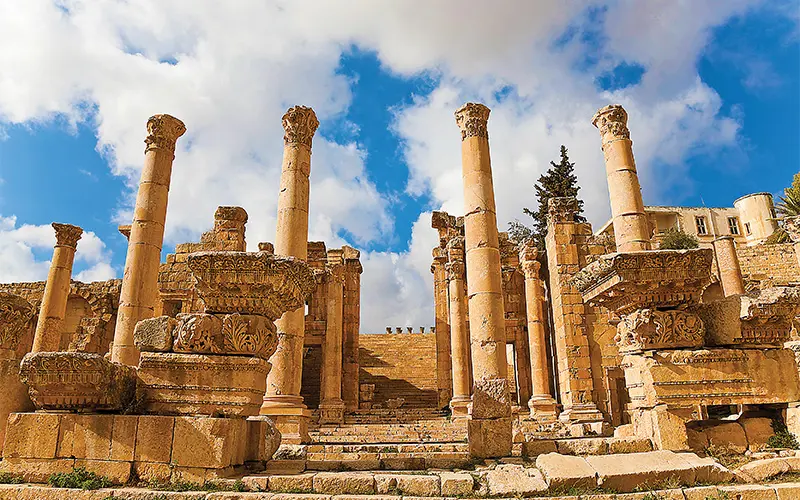
Jerash is one of the best-preserved ancient cities in the Middle East and an essential stop on any Jordan sightseeing itinerary.

Although the site has much older origins, Jerash flourished under Roman rule. Walking through its monumental gateways and public spaces gives you an extraordinary sense of what life might once have been like here.

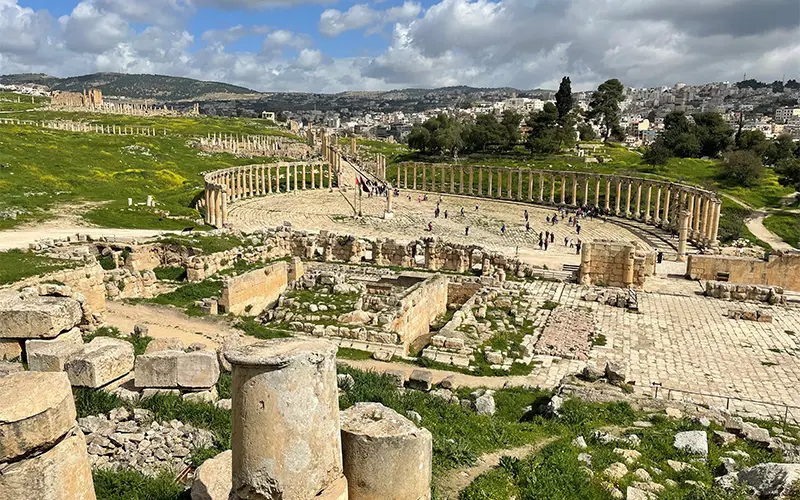
Enter through Hadrian’s Arch before exploring the remains of the Hippodrome, where crowds once gathered to watch sporting events and chariot races. From there, continue towards the sweeping Oval Plaza, surrounded by an elegant curve of columns.

The Cardo Maximus, Jerash’s long colonnaded street, leads through the heart of the city. Look carefully and you may spot the grooves left by ancient cartwheels beneath your feet.

Other highlights include the Temple of Artemis, the Temple of Zeus and the impressive South Theatre. The theatre remains renowned for its acoustics, and performances are sometimes held among its rows of stone seating. Here you can climb to the top of the steps for panoramic views over the site. You’ll often be serenaded by some Jordanian veterans playing the bagpipes and drum.

Jordan-Jaresh2-800x500.jpg

Jordan-Jaresh-800x500.jpg

Wadi Rum: An Otherworldly Landscape

Venture south into Wadi Rum, following the footsteps of the legendary Thomas Edward Lawrence. Here you’ll see the monolithic mountain, the Seven Pillars of Wisdom, thought to be the inspiration for the title of Lawrence’s book.

The Wadi Rum defies a typical desert stereotype. Instead of endless dunes and the occasional oasis, this landscape is peppered with sandstone mountains that dot the horizon. It’s perhaps reminiscent of Americas Monument Valley. With its other worldly appearance, it’s unsurprising that so many movies have been made here.

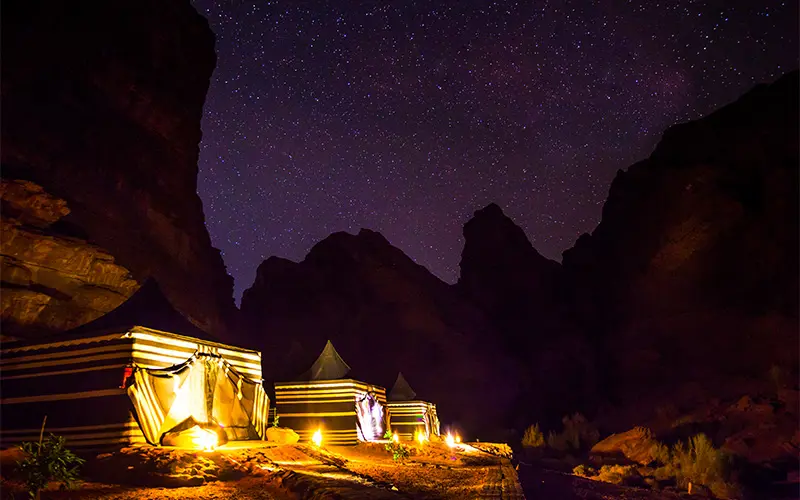
Sunsets are mesmerising, as are the sunrises. Find the perfect rock to use as a viewing platform and watch as the sun slowly descends behind the sandstone mountains. As day turns to night, look to the skies. While there is still a little light pollution from nearby camps, look up and it’s easy to spot familiar constellations amongst the thousands of stars.

An optional trip could take you to a site where you can use telescopes for a closer look, those visiting around March may have the opportunity to see Sirius “the diamond of the night sky”, Beetlejuice “the friendly girl next door, the Beehive, Orion’s Nebula found in the sword of Orion, Polaris “the North Star” and its companion Polaris B.

Madaba and Mount Nebo: Where History and Faith Intertwine

Considered the 'City of Mosaics', Madaba is home to churches and archaeological sites decorated with remarkable Byzantine and Umayyad mosaics. Wander through the streets, where you’ll find small shops and cafés. Keep your eyes peeled for street vendors selling freshly squeezed pomegranate juice and enjoy a taste of this refreshing drink.

Head to the Church of Saint George where you’ll see a mosaic of the oldest surviving geographical depiction of the Holy Land. Dated back to the 6th Century AD, the map was uncovered in the late 19th Century, and while it has been damaged over the years, what remains is incredibly intricate in design and beautiful to sea. Within the mosaic, you’ll see boats travelling on the Dead Sea, the city of Jerusalem with Saint Stephens Gate and Damascus Gate, fish swimming in the River Jordan and a number of biblical sites.

Just a short drive from Madaba is Mount Nebo. According to biblical tradition, this is where Moses looked out across the Promised Land. On a clear day stand on the viewing platform and take in the spectacular panoramas that includes the Dead Sea and Jerusalem.

While here, you can step inside Memorial Church of Moses, and see beautiful mosaics that have been uncovered during archaeological digs, and outside the Serpentine Cross sculpture created by Italian artist Gian Paolo Fantoni. 

Jerash is absolutely a highlight. I’ve never been to a better Roman site outside of Italy – it is on a huge scale and so well preserved. We loved exploring the hilltop temple ruins and walking along the colonnaded streets and open plazas – it really is like stepping back in time.

Stuart, Product Portfolio Manager

Jordan-Wadi-Rum-800x500.jpg

Jordan-Madaba-800x500.jpg

Petra: The Rose-Red City Half as Old as Time

No visit to Jordan is complete without a visit to Petra, but it’s safe to say that this experience is more spectacular than you can imagine.

Built and expanded by the Nabataeans more than 2,000 years ago, Petra became an important trading centre connecting Arabia with Egypt and the Mediterranean. Its architects carved elaborate tombs and temples directly into the sandstone cliffs while creating an ingenious system of channels, dams and reservoirs to manage water.

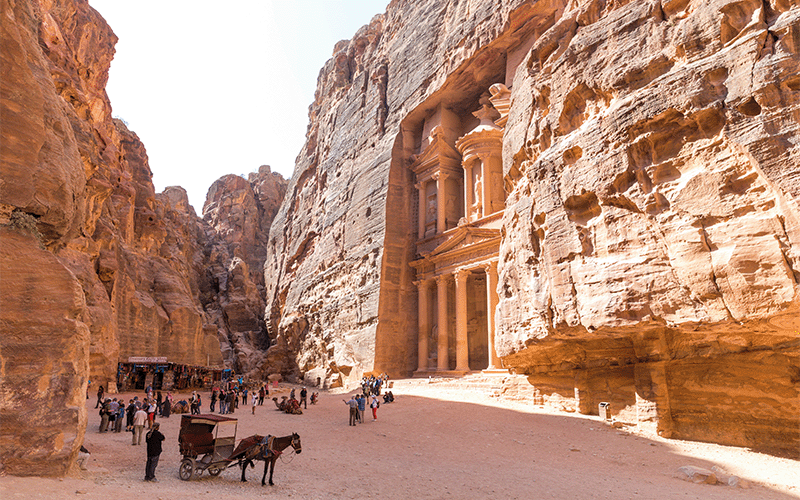
The approach to the city is part of the experience. You’ll start with a leisurely 0.75 mile walk through the Siq, a narrow canyon with cliff-faces up to 80m high. Eventually, the gorge narrows and the Treasury appears through a slim opening in the rock. As you step forward, its entire façade comes into view. And it is breathtaking.

Known locally as Al-Khazneh, the Treasury stands almost 40 metres high. Its columns, pediments and carved figures demonstrate the remarkable skill of the Nabataean builders.  At different times of day, the Treasury appears to change colour – with a golden hue in the morning and rose-red in the afternoon.

The Treasury may be Petra's most recognisable monument, but it marks only the beginning of the ancient city.

The Classic Trail at Petra takes you from the Treasury, down the Street of Facades and the Nabatean Theatre, along the Colonnade to the Qasr-Al-Bint (the Palace of the Pharaoh’s Daughter). Compared to many of the surrounding buildings that lie in ruins, this is one of the monuments of Petra that appears to be remarkably intact. With plenty of free time to explore further, there are various routes off the classic trail that you can take to discover more of this expansive archaeological site.

Feeling energetic? Climb almost 800 steps to visit Ed-Deir, the Monastery, it can be hard work with many of the steps having worn away, although there are a few places for you to pause and take in the view. It has a similar look to the Treasury but is much bigger and due to its remote location, often quieter. The High Trail will take you up and across to see the Urn Tomb, Silk Tomb, Corinthian Tomb and the Palace Tomb which are collectively known as the Royal Tombs each with their own distinguishing features.

The Dead Sea: Float Your Cares Away

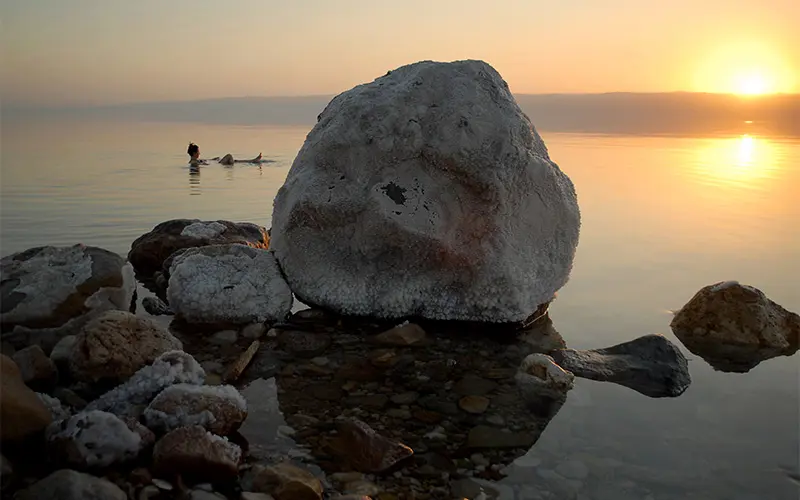
At 423 meters below sea level, the shores of the Dead Sea mark the lowest point on earth, and it forms part of the border with Israel. Due to the high salinity of the water aquatic organisms and plants can’t survive here – hence its name. You don’t swim in the Dead Sea, you enjoy a surreal floating experience. And you’ll often see people reading books and magazines as they lay back and relax in the water.

The Dead Sea is known for its mineral-rich water and mud, believed to have therapeutic properties, and on many of the beaches you will find pots containing the distinctive dark mud. It’s recommended that you cover yourself in mud and sit in the sun for a short while until you feel that it is drying up. Then, simply walk down to the water and wash it off.

The main source of water for the Dead Sea is the River Jordan. On the Eastern bank of the river is ‘Bethany Beyond the Jordan’ and is believed to be the place where John the Baptist lived and preached. Over the last 30 years, excavations have unearthed ancient churches, baptismal pools and caves and played a big role in understanding of Christianity in the region and it has been recognised as a UNESCO World Heritage Site. You might choose to visit this site on a tour to Jordan, and while here, you’ll see a range of the excavations, the “modern” St. John the Baptist Church and marble steps that lead down to the river. 

Petra, Jordan 800X500

Jordan-dead-sea-800x500.jpg

See the best sights in Jordan

From Roman ruins to otherworldly deserts, from ancient mosaics to natural spa treatments, Jordan offers a journey through time and across diverse landscapes. Each of these five sights contributes to the rich tapestry that makes Jordan an unforgettable destination for travellers.

Visit Jordan logo blue.jpg

We can take you there...

  1. Jordan's Ancient Wonders

    Discover historic and biblical sites, explore the 'Lost City' of Petra and soak up magical desert landscapes as you immerse yourself in Jordan's treasures.

    • Return flights
    • 7 nights in 4-star hotels, 1 night in a Desert Camp
    • 14 meals: 7 breakfasts, 2 lunches, 5 dinners

    8 days from
    £2,369
  2. Jordan's Ancient Wonders at Christmas

    Discover historic and biblical sites, explore the 'Lost City' of Petra and soak up magical desert landscapes as you immerse yourself in Jordan's treasures at Christmas

    • Return flights
    • 7 nights in 4-star hotels, 1 night in a Desert Camp
    • 14 meals: 7 breakfasts, 2 lunches, 6 dinners including Christmas Eve gala dinner

    8 days from
    £2,299
    was £2,699