Malta’s history is rich and intriguing. Some 5,000 years ago, before records began, the islands were home to an ingenious civilisation. Little is known about these prehistoric people, but their legacy endures in the form of extraordinary UNESCO-listed megalithic temples, constructed around the 3rd and 4th millennia BC.
These monumental buildings rank among the earliest free-standing stone structures in the world and reveal an impressive level of architectural, artistic and technological skill for their time.
Discover some of the world’s oldest free-standing monuments at Ggantija
On the island of Gozo, the two temples of Ġgantija are thought to be the world’s oldest surviving free-standing monuments – around 1,000 years older than Stonehenge and the Great Pyramid of Giza.
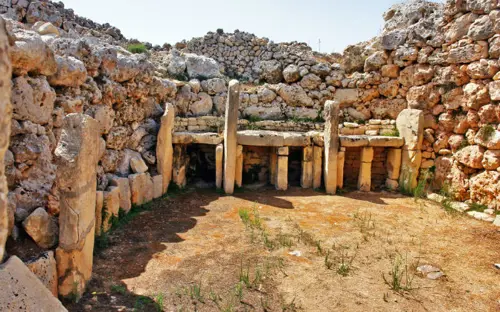
The two temples have separate entrances but are enclosed within a single outer megalithic wall. Their builders made clever use of Malta’s local stone, using hard-wearing coralline limestone extensively within the complex and softer globigerina limestone for features such as doorways and decorative elements.
Legend has it that these vast structures were created by giants and so they were named accordingly. Translated from Maltese, Ġgantija means giant.
Admire skilled craftsmanship at Mnajdra
Malta’s extraordinary temples of Ħaġar Qim, Mnajdra and Tarxien are incredible works of art constructed by people who had very limited resources at their disposal. The individual temples found at the Mnajdra site are particularly impressive, occupying a remote coastal location they are a fascinating example of skilled craftsmanship.
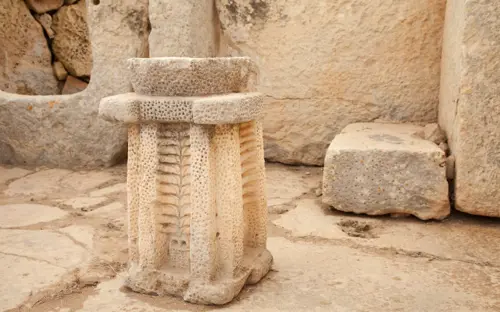
Perhaps most intriguing is the relationship between the South Temple at Mnajdra and the movement of the sun. Its doorway is aligned with the sunrise during the spring and autumn equinoxes, while at the summer and winter solstices the sun’s rays illuminate different parts of the temple interior.
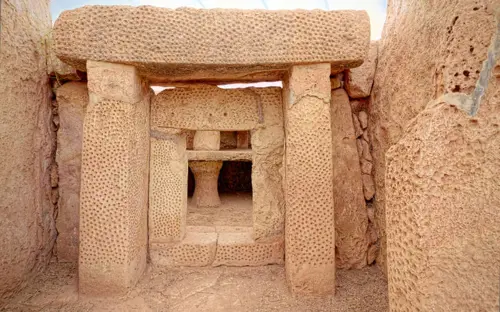
Building ended mysteriously around 2,500 BC
Although each of Malta’s megalithic temples is individual and unique, their layouts, decoration and the artefacts discovered within them suggest that they formed an important ritual focus for the communities that built them. Their scale and complexity also reveal a society capable of impressive architectural and technological achievements.
The building of these magnificent structures came to an end around 2500 BC, although exactly why Malta’s remarkable temple-building culture disappeared remains uncertain. What its people left behind, however, is an extraordinary archaeological legacy that provides a tantalising glimpse into life on the Maltese islands thousands of years ago.
Malta’s fascinating story continues through the many later periods of its history. On Travelsphere’s Discover Malta tour, you can explore heritage spanning the centuries in Valletta, Rabat, Mdina, Mosta and the Three Cities, as well as having the option to discover the neighbouring island of Gozo.
Why visit Malta with Travelsphere?
Every Travelsphere holiday offers exceptional value for money. Included in the price are return scheduled flights/rail travel and internal flights, where applicable, overseas transfers and transportation, carefully chosen hotels, many meals and excursions and the services of a Travelsphere Holiday Director or Local Guide.
Discover the best time to visit Malta.



