From palaces at the heart of powerful empires to castles overlooking mountain lakes, Europe’s grand buildings tell extraordinary stories. Discover the people who shaped them, the landscapes that surround them and the experiences you can enjoy with Travelsphere.
Fairy-tale fantasies
Europe’s history is written not just in the great events of the centuries, but in the walls of the grand buildings of its mighty rulers. The landscape is home to thousands of palaces and castles, the former – and sometimes current – residences of royals, emirs and emperors. Some were built to protect the powerful occupants from attack, while others were summer retreats to show off their impressive wealth. Here, we select a few to help you indulge your fairy-tale dreams.
Doge’s Palace, Venice
Go behind the walls of Doge’s Palace on St Mark’s Square and you’ll enter the seat of a powerful empire known fancifully as the ‘Most Serene Republic of Venice’. But what went on in this building wasn’t always peaceful. Linked to the palace by the Bridge of Sighs over the Rio di Palazzo, lie the torture chambers and cells the notorious lover Casanova was forced to call home. He made his escape in 1756, but others weren’t so lucky. The bridge takes its name from the belief that prisoners would sigh as they made their way across it and saw the beauty of Venice for the last time.
If you wander the labyrinth of rooms in the palace, you’ll see priceless works of art including Tintoretto’s ‘Paradise’ covering an entire wall of the Grand Council Chamber, where the dukes would plot their battles against the Ottoman Empire.
Topkapi Palace, Istanbul
Speaking of the Ottoman Empire, at the height of its power in the 16th century, it extended from the Danube to the Persian Gulf and from the Caspian Sea to Morocco. The centre of this formidable state was Istanbul, and the heart of Istanbul was Topkapi Palace.
Founded by Mehmed II in 1459, this vast residence of the sultans was fashioned over the following four centuries in an Oriental style with courtyards and gateways. Only a favoured few would make it beyond the first, bustling with traders. Now you can get closer to the harems and private quarters to see examples of the sultans’ wealth in the Throne Room and Treasury; from copper plates in the Confectionery House, where sweets were produced, to the emerald-studded Topkapi Dagger and one of the world’s largest diamonds.
On Treasures of Turkey, you can choose an optional half-day excursion to Topkapi Palace during your stay in Istanbul.
The Alhambra, Granada
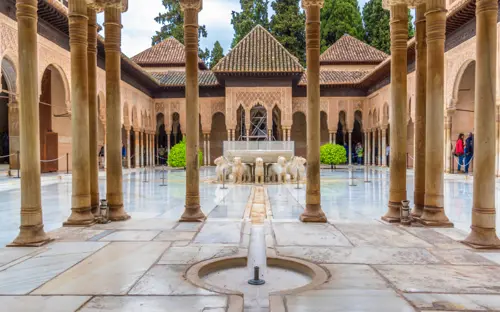
Located high above Granada, the fortified citadel of the Alhambra Palace is Europe’s most glorious example of Islamic architecture. A royal residence of the Nasrid emirs of Al-Andalus, this complex of palaces is predominantly Moorish and Renaissance in style. Overlooked by the snowy peaks of the Sierra Nevada, the fortress was protected by the banks of the River Darro. Venture beyond the forbidding walls and you’ll get an appreciation of its splendour at the Palacios Nazaríes, the lion fountains of the Patio de los Leones, and the reflecting pools of the Patio de los Arrayanes.
After the fall of the Nasrid dynasty in 1492, the Alhambra Palace became the court of the Catholic monarchs and it was the Holy Roman Emperor, King Charles V, who left his mark with the monumental Palacio de Carlos V. Although by the time it was finished, he was long dead.
Our A Week in Andalucia tour includes the Alhambra’s halls, patios and fountains, together with the Generalife Gardens. This combination gives you the opportunity to appreciate both the palace architecture and its garden surroundings.
Bran Castle, Transylvania
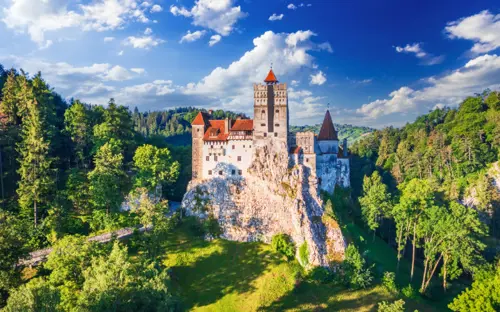
Nestled in dense forest in Transylvania, the story of Bran Castle is worthy of a tale as famous as the fictional one that draws people here. Bram Stoker was inspired to write Dracula by the bloodthirsty antics of a 15th century prince called Vlad the Impaler who, as son of Vlad Dracul, would use the name Dracula ‘Son of Dracul’.
But Stoker never went to Transylvania, and it’s now thought that Vlad the Impaler never set foot in Bran Castle. The true story is a bit of marketing magic by the communist authorities looking to increase tourism to the area in the 1960s. By linking Vlad Țepeș – Vlad the Impaler’s Romanian name – this Gothic castle on the mountain pass between Transylvania and Wallachia entered the history books.
Sintra National Palace, Portugal
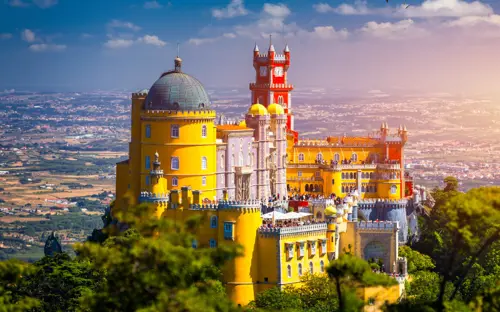
Sintra National Palace is instantly recognisable by the two enormous conical chimneys rising above its white walls. These distinctive features crown the royal kitchen, offering a practical explanation for one of Portugal’s most unusual palace silhouettes. The building developed over centuries as successive monarchs adapted and extended their residence.
On our Lisbon Coast – Historic Towns and Spectacular Sintra tour, you will step inside the palace to discover richly decorated rooms with colourful tiles and mosaics. Afterwards, there is free time to explore Sintra’s streets, browse its shops or settle into a café. A travesseiro, the local pastry filled with almond cream, makes a tempting accompaniment to the day’s royal discoveries.
Spiez Castle, Switzerland
Loved more for its setting than architectural splendour, Spiez Castle is surrounded by vineyards and overlooks one of the prettiest bays in Europe. If you go to the top of the tower, the reward is stunning views of the Bernese Oberland, where the luxury trains of the Swiss Railways journey through the mountains and valleys.
A walk through the castle is a trip through 1,000 years of the stories of its former residents, including the nobleman Franz Ludwig von Erlach, who fathered 37 children with his two wives. The carved ceiling in the Banqueting Hall makes it the most beautiful of the rooms, while a stroll in the grounds reveals an aromatic herb garden. To try the local wine, we recommend you go to the village and sip a glass as you gaze at the lake.
Bled Castle, Slovenia
Perched on a steep cliff above Lake Bled, Bled Castle has a setting worthy of a storybook. First mentioned in a document in 1011, it is among Slovenia’s oldest recorded castles. Its long history includes centuries of ownership by the Bishops of Brixen, whose estates were administered by local officials and governors.
The castle features in the included sightseeing on Scenic Slovenia & Lake Bled, with views across the lake adding to its appeal. During the same day’s exploration, you will also take a traditional pletna boat to Bled Island, giving you another perspective on this beautiful landscape.
Trakai Castle, Lithuania
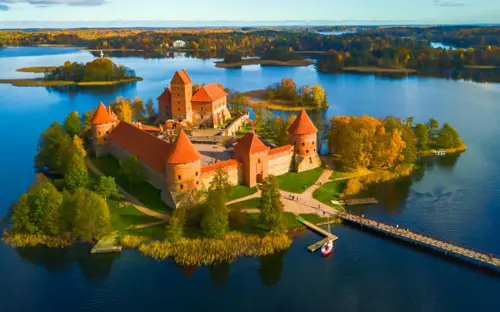
Set on an island in Lake Galvė, Trakai Castle’s Gothic towers rise above the water in a scene worthy of a fairy tale. A long wooden bridge connects the island to the shore, offering lovely views of the castle as you approach.
Built in the 14th century, the castle was the residence of the Grand Dukes of Lithuania. However, it fell to ruins in the 17th century and was rebuilt in 1952. It now houses a history museum, bringing together an atmospheric location and the opportunity to discover more about the area’s past.
On our Grand Baltic Explorer tour, you can choose an optional excursion to Trakai Castle and its history museum after your guided sightseeing in Vilnius.
Rundāle Palace, Latvia
From medieval strongholds, Europe’s royal story moves into the world of grand country residences at Rundāle Palace. Built as a summer residence for Ernst Johann Biron, Duke of Courland, it was designed by Francesco Rastrelli, the architect also associated with St Petersburg’s Winter Palace. Construction began in 1736, expressing the ambitions of a duke on an impressive scale. Rundāle Palace history
Our Grand Baltic Explorer includes a visit to this Baroque palace on the journey from Riga towards Vilnius. Its architectural grandeur adds another chapter to a holiday exploring the distinctive histories of the Baltic states.
Schönbrunn Palace, Vienna
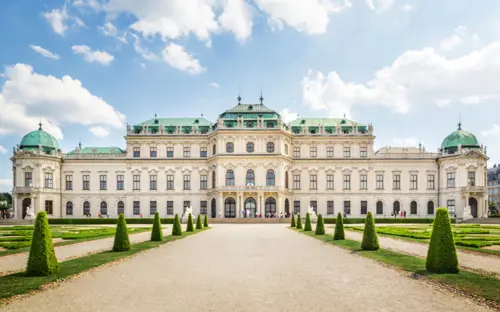
The Austrian palace of Schönbrunn tells a story of imperial ambition. Under Maria Theresa, a former hunting lodge was remodelled and extended into a magnificent summer residence, becoming a centre of court and political life. Its transformation captures the scale and splendour associated with the Habsburg dynasty.
On our Imperial Capitals – Budapest, Vienna & Prague tour, Schönbrunn’s Rococo style and the grandeur of the Hofburg Palace feature among the sights on your included morning tour of Vienna.
Explore with Travelsphere
Discover these remarkable buildings as part of a wider European adventure with Travelsphere. From palace visits in Portugal and Spain to lakeside castles in Switzerland and Slovenia, our escorted tours bring historic places into journeys filled with scenery, culture and local discoveries. Explore the linked itineraries to find your next holiday and see which visits are included or available as optional excursions.
See all our European tours.



