Facts about Italy
1. Florence paved the way in Europe
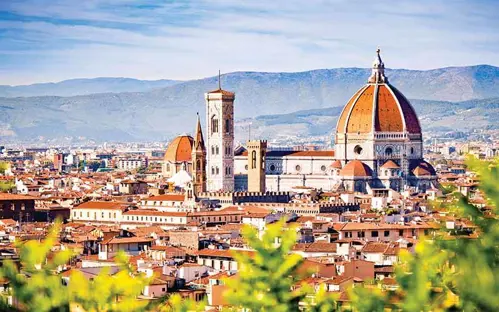
Florence can be recognised for at least one impressive architectural accomplishment: it was the first city in Europe to have fully paved streets. This practical upgrade in 1339 reflected the city’s growing wealth and civic pride.
And today, walking Florence’s compact centre is still the best way to experience the city’s Renaissance treasures up close, from Brunelleschi’s red-tiled dome and Giotto’s bell tower to the Uffizi’s galleries and Botticelli’s masterpieces.
Cross the Arno via the medieval Ponte Vecchio, browse the goldsmiths’ shops, and wander into the Oltrarno to find artisan workshops that have been carving wood, tooling leather, and shaping marble for centuries.
Markets like San Lorenzo showcase Tuscan produce, and quiet side streets lead to quiet piazzas and some of Italy’s best gelato. As the day fades, climb to Piazzale Michelangelo for a sunset view over terracotta rooftops and church spires. You can enjoy Florence at its most timeless.
Walk these beautifully cobbled streets for yourself on a Tuscany holiday.
2. Italy has made an outstanding contribution to art
Italy has been a centre for talented artists for centuries, but one period stands supreme: the Renaissance (14th to 16th centuries). From Leonardo and Michelangelo to Botticelli and Raphael, the Italian Renaissance masters reimagined anatomy, perspective and storytelling.
Their patrons, notably the Medici and papal courts, transformed cities into open-air galleries where politics, science, and art intertwined.
3. Pinocchio was originally published in a newspaper
Carlo Collodi’s wooden puppet first appeared in July 1881 in the children’s newspaper Giornale per i Bambini. Its episodic format, complete with cliffhangers, kept young readers rapt before the tale evolved into the much-loved story we know today.
4. The Roman Empire spanned three continents
Central to Italy’s rich history was the mighty Roman Empire. At its height, Rome governed roughly 2.3 million square miles across Europe, North Africa, and the Middle East, leaving roads, laws, languages, and city plans as a lasting legacy. In Italy, Roman ruins aren’t just tourist sights; they’re the spine of many modern towns.
Italy isn’t the only country where you can explore ancient Roman ruins. Jeresh is home to some of the best-preserved Roman ruins outside of Italy, and we visit them on our Jordan's Ancient Wonders tour.
5. Venice has 471 bridges
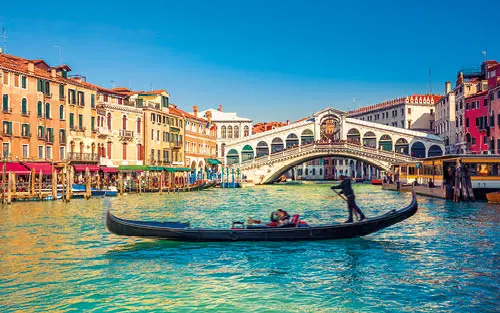
Venice, also known as “The Floating City”, is famous for its intricate network of canals often lined with palazzi (grand houses). Gondolas and boats are the primary modes of transportation in this ancient city built on a lagoon.
Spanning 118 islands, this iconic city boasts 471 bridges that connect one side of a canal to another. The oldest and most famous bridge is the Rialto Bridge, and until 1854, it was the only place you could cross the Grand Canal on foot.
Explore St Mark’s Square and the Rialto Bridge as you kick start a tour of Italy in style.
6. Italy’s drinking water is beautifully pure
The drinking water in Italy is not only safe but also respected for its exceptional quality. In fact, it often rivals bottled water and is subject to rigorous quality control measures. In many cities, you’ll find chilled sparkling water on tap in public dispensers; a sustainable, very Italian luxury.
Read our guide to the best Italian lakes to visit or head there in person on our Italian lakes tour.
7. Rome has Europe's largest film studio
Rome’s Cinecittà Studios is Europe’s largest film studio. It has provided sets for many iconic movies throughout the years, including beloved classics such as Roman Holiday (1953), Ben-Hur (1959), The Godfather Part III (1990), and Gangs of New York (2002).
8. Italy is a major olive oil producer
Italy is responsible for approximately 20% of global olive oil production. Each region within Italy boasts its own blend of olive oil, each distinctively representing the diverse soil and climate conditions found throughout the nation.
In northern Italy, the flavours are quite delicate, but as you head south, the flavours become stronger and can become quite peppery. Olive oil tastings can be as nuanced as wine.
9. San Gimignano has a towering history
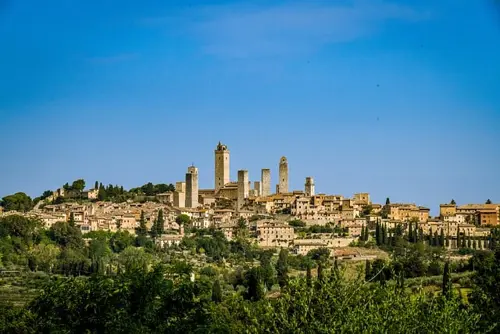
San Gimignano in Tuscany is renowned for its unique ‘Manhattan of the Middle Ages’ skyline adorned with medieval stone towers. At one point, the city boasted an astonishing 72 towers, symbols of wealth and success for affluent Medieval families who engaged in friendly rivalry to build the tallest tower. Today, 14 survive, framing views across the Val d’Elsa.
10. Italy is a style superpower
Italy is respected worldwide as a leading fashion hub, with influential cities like Milan at its forefront. This stylish country gave us prestigious brands such as Gucci, Prada, and Versace. However, Italy’s legacy extends beyond high fashion, built on unparalleled regional craftsmanship.
This dedication to quality is evident in heritage ateliers specialising in exquisite leatherwork in Florence, luxurious silk from Como, and celebrated artistic glassmaking on the island of Murano.
11. It’s traditional to throw a coin into the Trevi Fountain
It is a popular tradition to throw a coin over your shoulder into this famous fountain in Rome. According to this tradition, throwing a single coin guarantees your future return. However, throwing two or three coins could guarantee finding love or even marriage. So many visitors participate in this ritual that the fountain has to be emptied twice a week.
The good news is that all the carefully collected coins support a local charity that funds food banks and welfare programmes.
12. Religion is a vital part of Italian culture
Religion plays a prominent role in Italian culture, with the majestic Vatican City serving as the spiritual and administrative centre of the Roman Catholic Church. The majority of Italians identify as Catholics, and when visiting Italy, you will encounter numerous chapels and churches.
From the sublime artwork of the Sistine Chapel to Florence’s iconic Duomo di Milano, or viewing the Volto Santo relic, a sacred wooden sculpture of Christ thought to date back to 742 AD, in Romanesque St Martin Cathedral, no two are the same.
13. Italy contains two independent states
Italy is home not only to one, but to two independent countries: Vatican City, the spiritual centre of Roman Catholicism, and the hilltop Republic of San Marino. Both have their own fascinating histories and unique cultural traditions.
It’s hard to miss the colourful uniforms of the Vatican’s Swiss Guards, sworn protectors of the Holy See, as you stand in the Piazza San Pietro (St Peter’s Square) and take in the beautiful architecture of St Peter’s Basilica.
14. The Leaning Tower of Pisa was used in World War II
During the Second World War, when Italy was under Nazi occupation, the Leaning Tower of Pisa served as an observation post. Today, it’s a case study in engineering, where careful interventions have stabilised, but not straightened, its famous tilt.
15. Italians are obsessed with cheese
Italians don’t just love cheese on their pizza and pasta; they’re masters of its creation. With over 2,500 traditional cheeses, Italy boasts the world’s widest selection, offering iconic varieties such as Parmigiano Reggiano, mozzarella, ricotta, provolone, and Gorgonzola.
For foodies, a visit to the northern region of Lombardy is essential, as it alone produces a staggering 77 varieties, including world-renowned staples such as Grana Padano and the creamy mascarpone.
16. Ancient civilisations shaped Italy
Before Rome became the centre of a powerful empire, Italy was the birthplace of the ancient Etruscan and Samnite civilisations. These societies in southern Italy shaped art, language and urban planning before Rome’s rise. Their necropolises, ceramics and metalwork still spark revelations in museums and excavations.
17. Bologna has two famous towers
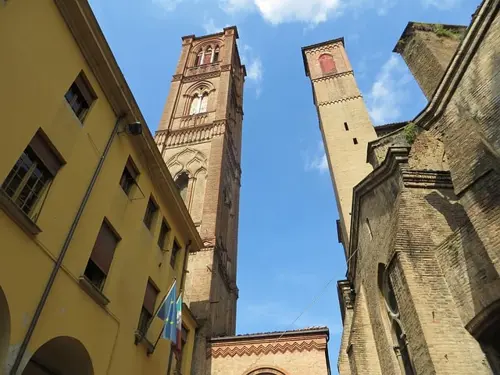
Bologna is renowned for its iconic Le Due Torri, or Two Towers: Asinelli and Garisenda.
Interestingly, the tower of Garisenda leans even more than the Leaning Tower of Pisa. Leaning 4 degrees compared to Pisa’s 3.9 degrees. Restoration work is hoped to begin on the tower soon to stabilise its current slant for future generations.
18. Europe’s oldest university is in Italy
The University of Bologna holds the title of the oldest university still in operation today. Founded in 1088, this esteemed institution has maintained a legacy of academic and scientific excellence for over a millennium.
With buildings dotted throughout the city of Bologna, you are bound to wander past some of the stunning architectural masterpieces that make up this university. Often open to the public, the buildings make for a unique view of Italy.
19. Costa Smeralda is known as the Caribbean of Europe
Italy boasts numerous beautiful beaches, but the Costa Smeralda, situated on the northeast coast of Sardinia, is renowned worldwide for its stunning natural beauty. Pristine white-sand beaches, emerald-green and turquoise waters that rival the Caribbean, and dramatic rocky coves attract millions of tourists each year.
This coastal paradise pairs unspoiled scenery with a glamorous, high-end lifestyle of luxury resorts, designer boutiques in Porto Cervo, gleaming superyachts, and charming towns.
Dip your toes in the water on our Sardinia’s Emerald Coast tour.
20. Matera sleeps in ancient cave homes
In southern Italy, Matera’s Sassi districts consist of remarkable prehistoric cave dwellings carved into the honey-coloured limestone rock, making them among the world’s oldest continuously inhabited settlements.
Now a UNESCO World Heritage site, this architectural wonder offers incredible sights, including rock churches with frescoes, restored cave houses, and hotels. Its atmospheric, timeless look has also made it a celebrated film location for major productions such as Ben-Hur, The Passion of the Christ, and No Time to Die.
21. Italians can be superstitious
Italian culture is rich in superstitions, such as avoiding encounters with black cats and touching iron for good luck. It’s even considered unlucky to place a hat on a bed, and some hotels avoid having a 17th floor, as the number is considered unlucky. You’ll also hear 'in bocca al lupo' ('into the wolf’s mouth'); the equivalent of 'break a leg'.
Pick up phrases as you sip spritz on a holiday to Portofino.
22. Italy is vulnerable to earthquakes
Situated at the meeting of the African and Eurasian plates, Italy encounters frequent seismic activity. This has influenced building techniques and restoration practices, especially in the Apennines and the south.
See careful conservation at sites like Paestum on our Pompeii, Paestum & Herculaneum tour.
23. Italian isn’t the only language used
Although Italian is the official language of Italy, the country is home to a wide variety of local languages and dialects. In northern Italy, German is spoken due to historical ties and close proximity to Austria. Different regions in Italy have their own unique languages, such as Calabrian (Calabrese), Venetian, Sicilian, and Neapolitan.
24. The country is named after cows
The origin of the name 'Italy' has been a subject of debate. One school of thought believes the name Italy could have been derived from the term ‘Italus’, which means ‘calf land’. This could be connected to early agricultural practices, regional myths, or the fact that Italians do enjoy milk and cheese.
25. The 20th century reshaped the nation
Benito Mussolini, a prominent figure in European totalitarianism, held political power in Italy from 1922 to 1943. He founded and led the National Fascist Party. Il Duce governed with a firm hand until he was executed by soldiers, and after the war, Italy became a republic in 1946.
26. Tomatoes were introduced to Italy from Peru
Despite a common misconception, tomatoes did not originate in Italy. They were actually brought to Italy from Peru in the 16th century and have since become a fundamental ingredient in Italian cuisine. Today, DOP-protected San Marzano tomatoes, in particular, are prized for their sweet acidity and low seed content.
Try the real thing near Naples on our Amalfi Coast, Pompeii & Capri tour.
27. Pizza's birthplace is Naples
When it comes to notable edible contributions from Italy, the invention of pizza undoubtedly holds a significant place. Naples, often regarded as the birthplace of pizza, introduced this culinary delight to the world in the 19th century.
Although there are believed to be references to an ancient Greek flatbread that may be a precursor to pizza. Whichever origin story you side with, we can all agree that Italy has certainly perfected the pizza.
28. Football is a national passion
Calcio, Italian for football, is a national passion in Italy. Italy’s clubs are community pillars, and the Azzurri have won the FIFA World Cup four times, placing them in joint second place for the most World Cup titles. Match days turn piazzas into outdoor living rooms as families huddle around TVs and radios.
Catch the atmosphere in cafés from Rome to Sicily on the Grand Tour of Italy.
29. Italy has the most UNESCO World Heritage sites
Italy boasts an unparalleled distinction: it is the country with the most UNESCO World Heritage Sites globally, currently standing at 61. This wealth of history encompasses masterpieces such as the Roman Colosseum and the entirety of Venice, as well as natural wonders like the Dolomites.
Every region offers a profound cultural experience, inviting you to discover layers of human history and artistic genius on every visit.
30. Pasta is a way of life
It is widely recognised that Italians have a profound passion for pasta, and an intriguing statistic supports this claim: around 23–28 kg of pasta is eaten per person annually in Italy.
There are over 350 recognised pasta shapes, ranging from long strands, such as spaghetti and linguine, to hollow tubes, like penne and rigatoni, and flat, broad varieties, like fettuccine and lasagne. Smaller, decorative shapes, such as farfalle (bow ties) and fusilli spirals, are designed to effectively capture lighter or creamier textures.
Crucially, many regional varieties remain a labour of love, crafted by hand, such as the famous orecchiette (little ears) in Puglia, which are perfectly shaped to cradle hearty sauces like cime di rapa. In the city of Bari, you can still witness the tradition on the ‘Street of the Orecchiette’ where nonnas (grandmothers) sit outside their homes, expertly shaping and drying the pasta.
Discover the 35 Italian foods you absolutely need to try.



